x402-chainlink





Empowering the next generation of the decentralized web with seamless, borderless micro-monetization.
x402-chainlink
Preface
Monetizing Web3 APIs and enabling headless AI agents to autonomously pay for the premium data today means either building a centralized database to track user deposits, or forcing users to sign clunky, expensive transactions for every API call.
x402-Chainlink solves this. Instead of a centralized processor acting as the middleman, we use Chainlink CRE as a verifiable, decentralized backend. The x402 protocol handles the HTTP-level negotiation, allowing servers to demand payment and clients whether human users or autonomous AI agents to automatically fulfill it via smart contracts, returning a cryptographically secure token (like a Macaroon) to access the resource.
Overview
x402-chainlink is a self-sovereign payment SDK that acts as the "Stripe for Web3." It enables developers to seamlessly monetize APIs, digital resources, and AI agent workflows using standard HTTP 402 (Payment Required) protocols, entirely secured by the Chainlink Runtime Environment (CRE).
Unlike centralized payment processors or clunky escrow contracts, x402 allows users to maintain absolute custody of their funds. Buyers simply sign an off-chain intent to pay, and the Chainlink Decentralized Oracle Network (DON) handles the rest—verifying balances and executing trustless, atomic settlements on-chain.
Key Features
For the Agentic Economy
- Machine-to-Machine (M2M) Payments: AI agents and headless clients can autonomously intercept 402 responses, request cryptographic signatures, and pay for the resources they consume.
- Universal API & dApp Gating: Drop-in, decentralized paywalls using standard HTTP headers (
PAYMENT-REQUIRED,PAYMENT-SIGNATURE).
For the Developer & User Experience
- Gasless Checkout (EIP-2612): Token permits eliminate separate, expensive "Approve" transactions, delivering a frictionless one-click UX.
- Extensible Architecture: A built-in
ExtensionRegistrywith strict JSON schema validation makes it easy to add metered usage, subscriptions, or tipping.
For Security & Infrastructure
- Unstoppable Settlement: Chainlink DONs provide BFT consensus to verify signatures off-chain and settle token transfers trustlessly via the
X402Facilitatorcontract. - True Self-Sovereignty (EIP-712): Zero centralized custody. Users authorize payments via secure, off-chain cryptographic signatures.
Key Use Cases
- API Monetization (Machine-to-Machine): Charge per API call without requiring users to buy subscriptions. Perfect for AI models, oracle data feeds, or heavy compute tasks.
- Decentralized Paywalls: Monetize premium content, articles, or digital media natively via user wallets.
- Frictionless Token-Gating: Verify NFT or token holdings directly at the HTTP layer before serving content.
- Automated Micro-transactions: Enable streaming payments for continuous services (e.g., video streaming, cloud storage).
Architecture & Protocol Flow
The SDK abstracts the entire x402 negotiation and on-chain settlement process. Under the hood, Chainlink CRE acts as the secure, decentralized verifier that confirms the payment on-chain and signs the authorization token.
The x402 Negotiation Sequence
sequenceDiagram
actor User as Client/Agent
participant SDK as x402 SDK Client
participant Wallet as Wallet Signer
participant API as Protected API Server
participant CRE as Chainlink CRE
participant Contract as X402 Facilitator
participant Token as ERC20 Token
Note over User,Token: Phase 1: Discovery & Payment Request
User->>SDK: Fetch protected resource
SDK->>API: GET /api/resource
API-->>SDK: 402 Payment Required
Note right of API: Headers:
PAYMENT-REQUIRED: base64(Requirements)
Note over User,Token: Phase 2: Payment Authorization
SDK->>SDK: Decode payment requirements
User->>SDK: Approve payment
SDK->>Wallet: Request EIP-712 signature
Wallet-->>SDK: Sign PaymentAuthorization
SDK->>Wallet: Request EIP-2612 permit (optional)
Wallet-->>SDK: Sign Permit (gasless approval)
SDK->>SDK: Encode PaymentPayload
Note over User,Token: Phase 3: Verification & Settlement via Chainlink CRE
SDK->>API: GET /api/resource
Note right of SDK: Headers:
PAYMENT-SIGNATURE: base64(Payload)
API->>CRE: Forward Payload (action: "verify_and_settle")
%% CRITICAL: Off-chain Verification
critical Trustless Verification
CRE->>CRE: Verify EIP-712 Signature
CRE->>Token: Check Balance & Allowance (RPC)
Token-->>CRE: Balance sufficient
end
%% CRITICAL: On-chain Settlement
critical Immutable Settlement
CRE->>Contract: Broadcast Settlement Report
Note right of CRE: If permit: _executePermitIfNeeded()
Followed by safeTransferFrom()
Contract->>Token: transferFrom(payer, recipient, amount)
Token-->>Contract: Transfer success
Contract-->>CRE: Emits PaymentSettled Event
end
CRE-->>API: CREWorkflowResponse (Success + txHash)
Note over User,Token: Phase 4: Secure Resource Delivery
API-->>SDK: 200 OK + Resource Data + PAYMENT-RESPONSE receipt
SDK-->>User: Delivery Confirmed
SDK Usage
We built this SDK to be as intuitive as Web2 payment gateways. You don't need to be a blockchain expert to use it you can refer to the intuitive SDK Documentation for more details.
1. The Agentic Use Case (server-side)
Perfect for headless AI agents or scripts that need to autonomously pay for premium API resources using a funded wallet.
import { createWalletClient, createPublicClient, http } from 'viem';
import { privateKeyToAccount } from 'viem/accounts';
import { baseSepolia } from 'viem/chains';
import {
decodePaymentRequired,
selectPaymentRequirements,
createPaymentPayloadWithPermit,
encodePaymentSignature,
HTTP_HEADERS
} from 'x402-chainlink';
// 1. Initialize the Agent's Viem Wallet
const account = privateKeyToAccount('0xAGENT_PRIVATE_KEY');
const walletClient = createWalletClient({ account, chain: baseSepolia, transport: http() });
const publicClient = createPublicClient({ chain: baseSepolia, transport: http() });
async function fetchPremiumData(url: string) {
// 2. Make standard request, intercept the 402 Paywall
let response = await fetch(url);
if (response.status === 402) {
// 3. Decode server requirements and auto-select affordable option across chains
const required = decodePaymentRequired(response.headers.get(HTTP_HEADERS.PAYMENT_REQUIRED)!);
const requirement = await selectPaymentRequirements(required.accepts, publicClient, account.address, 'eip155:84532');
// 4. Agent autonomously signs EIP-712 Intent & EIP-2612 Gasless Permit
const payload = await createPaymentPayloadWithPermit(
walletClient,
publicClient,
2, // x402 version
requirement,
{ endpoint: 'https://cre.chainlink.example.com', network: 'eip155:84532' },
{ includePermit: true }
);
// 5. Retry request with cryptographic signature
response = await fetch(url, {
headers: {
[HTTP_HEADERS.PAYMENT_SIGNATURE]: encodePaymentSignature(payload)
}
});
}
return response.json(); // Returns unlocked premium data!
}
2. The Client Use Case
Perfect for frontend applications. This provides a "Stripe-like" one-click checkout experience by utilizing EIP-2612 permits, meaning the user doesn't have to pay gas just to approve tokens.
import { useWalletClient, usePublicClient, useAccount } from 'wagmi';
import {
decodePaymentRequired,
createPaymentPayloadWithPermit,
encodePaymentSignature,
HTTP_HEADERS
} from 'x402-chainlink';
export function PremiumArticle({ articleId }) {
const { data: walletClient } = useWalletClient();
const publicClient = usePublicClient();
const { address } = useAccount();
const unlockArticle = async () => {
if (!walletClient || !address) return alert("Please connect wallet");
// 1. Attempt to fetch premium content
const res = await fetch(`/api/articles/${articleId}`);
if (res.status === 402) {
const required = decodePaymentRequired(res.headers.get(HTTP_HEADERS.PAYMENT_REQUIRED)!);
const requirement = required.accepts[0];
// 2. Prompt MetaMask to sign intent & permit (One-click, gasless UX)
const payload = await createPaymentPayloadWithPermit(
walletClient,
publicClient,
2,
requirement,
{ endpoint: 'https://cre.chainlink.example.com', network: 'eip155:8453' },
{ includePermit: true }
);
// 3. Fetch premium content with user's signature
const premiumRes = await fetch(`/api/articles/${articleId}`, {
headers: {
[HTTP_HEADERS.PAYMENT_SIGNATURE]: encodePaymentSignature(payload)
}
});
const article = await premiumRes.json();
console.log("Unlocked Article:", article);
}
};
return <button onClick={unlockArticle}>Unlock for 1 USDC</button>;
}
Why Chainlink CRE?
The core innovation of this project lies in moving the heavy lifting of payment verification off the primary application server and into the Chainlink Runtime Environment.
| Benefit | How it works |
|---|---|
| Absolute Trust | The server and client are completely trustless. The CRE acts as the decentralized, unbiased referee that verifies the on-chain settlement and issues the access credential. |
| Chain Agnosticism | Because CRE observes multiple networks natively, your API can accept payments on Polygon, Base, Ethereum, or Arbitrum simultaneously—zero local RPC nodes required. |
| Low Latency | CRE workflows execute securely and rapidly off-chain, ensuring the HTTP request-response cycle remains blazing fast for modern web applications. |
Running SDK Examples Locally
Prerequisites
- Node.js v18.0.0 or higher
- npm or bun package manager
- Chainlink CRE CLI (For simulation we sould spwan a cre client in simulation mode and run the workflow locally)
- Clone & Install:
git clone https://github.com/your-org/x402-chainlink_1.git
cd x402-chainlink
- Set Up the Backend Server (Examples/backend):
# Navigate to backend example
cd examples/backend
# Install backend dependencies
bun install
# Create environment file
cp .env.local .env.local # Already exists, but you may want to customize
# Edit .env.local with your values
nano .env.local
# Run the backend server
bun run dev
- Set Up the AI Agent Client (Examples/app):
# Navigate to agent example (from repo root)
cd examples/agent
# Install agent dependencies
bun install
# Create environment file
cp .env.example .env
# Edit .env with your values
nano .env
# Run the agent client
bun start
Note: You need to have funded wallet to run the agent client.
- Set Up the Frontend Client (Examples/app):
# Navigate to frontend example (from repo root)
cd examples/app
# Install frontend dependencies
bun install
# Create environment file
cp .env.local.example .env.local
# Edit .env.local with your values
nano .env.local
# Run the frontend client
bun run dev
AI agent/Backend workflow example:
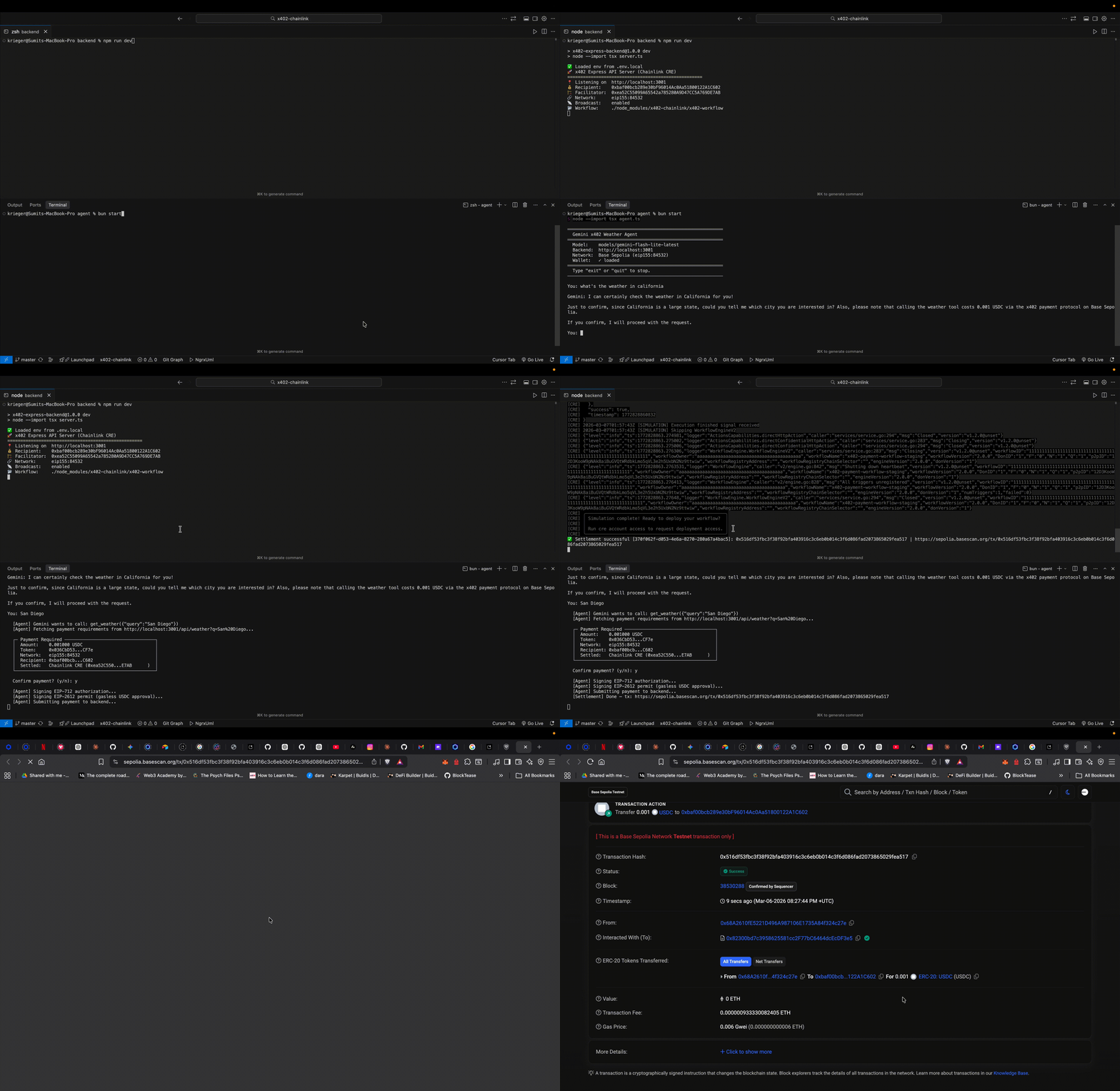
Workflow tx: 0x516df53fbc3f38f92bfa403916c3c6eb0b014c3f6d086fad2073865029fea517
Contributing & Next Steps
This project is open-source and actively seeking contributions. Future roadmap items include:
- Making the production deployment of the SDK with Chainlink CRE.
- Subscription/recurring payment models using Chainlink Automation.
- Native browser extension for background x402 automated settlements.
- Native integration with LangChain and AutoGPT.
Contact
Twitter - @Krieger
Mail - prsumit35@gmail.com
Acknowledgment
Thanks to Chainlink for providing the innovative and user-friendly framework and development guide for chainlink runtime environment and organizing the Convergence Hackathon that inspired me to create x402-chainlink. I would greatly appreciate any feedback or guidance from the judges.
References
- Chainlink Runtime Environment: Runtime Environment
- x402 Protocol: Protocol
- EIP-712: EIP-712
- EIP-2612: EIP-2612